

The Essential Guide to Shotgun Microphones for Filmmaking (2026)
In This Guide
- How Shotgun Microphones Work
- Indoor vs Outdoor Recording
- Choosing the Right Shotgun Microphone Type
- Placement & Boom Technique
- Recording Musicians & Singers
- Location Sound & Practical Recording
- Practical Filmmaking Workflow
- Professional Shotgun Microphones
- Common Mistakes to Avoid
Explore shotgun microphones: Best models · Major brands · Shop shotgun microphones
In the field of professional audio for video, the shotgun microphone is a foundational tool. Whether you are capturing dialogue for an independent documentary, recording voiceovers in a home studio, or managing audio for filmmaking and YouTube production, understanding how to select and deploy the right microphone is essential. Focusing on clarity, reliability, and real-world production usability, this guide explores the technical principles behind shotgun microphones and helps you make informed decisions based on your recording workflow.
Understanding Shotgun Microphone Technology
A shotgun microphone is technically a line-plus-gradient microphone. It uses an interference tube design, characterized by the slots running along the length of the barrel. These slots allow sound waves arriving from the front to enter the capsule directly, while sound waves arriving from the sides are phased out due to destructive interference. This is what provides the high degree of directionality associated with these microphones.
It is important to understand that directionality is frequency-dependent. High frequencies are more directional than low frequencies. As you move off-axis—meaning the sound source moves away from directly in front of the microphone—the frequency response will change. A high-quality shotgun microphone is defined by how naturally it handles this off-axis coloration. An inexpensive microphone will often make off-axis sound seem muffled or “hollow,” whereas a professional microphone will maintain a relatively neutral, albeit quieter, representation of the off-axis sound.
Indoor vs. Outdoor Recording
A common misconception among newer content creators is that a shotgun microphone is the universal solution for all recording scenarios. In reality, shotgun microphones are highly sensitive to reflections.
When used outdoors, a shotgun microphone is ideal because it rejects ambient noise and helps isolate the dialogue. However, when used indoors in an untreated room, the sound waves bounce off hard surfaces like walls, ceilings, and floors. These reflections enter the interference tube, often causing phase issues and a “boxy” or reverberant sound. For indoor dialogue recording, many professional sound recordists prefer a hypercardioid microphone (like the Sennheiser MKH 50) rather than a long-interference tube shotgun microphone, as it tends to be more forgiving in reflective environments.
Short vs Long Shotgun Microphones
Not all shotgun microphones provide the same degree of directionality. One of the most important distinctions is the length of the interference tube, which influences how narrowly the microphone responds to sound arriving from different angles.
Short shotgun microphones are generally the most versatile choice for filmmaking, interviews, music videos and creator-led productions. Their relatively forgiving pickup area makes it easier to keep a moving performer on-axis, particularly when one person is operating both camera and sound equipment. They are also physically easier to use on compact boom poles and camera rigs.
Long shotgun microphones provide greater directionality, particularly at higher frequencies, and can be useful when the microphone must remain farther from the subject. However, the narrower acceptance angle also demands more accurate aiming. If an actor, singer or presenter moves away from the microphone’s axis, the tonal balance of the recorded voice can change.
A longer shotgun should therefore not automatically be regarded as a better shotgun. For many small productions, interviews and music videos, the greater flexibility of a short shotgun microphone can be more useful than maximum directivity.
This distinction becomes particularly important when filming musicians. A singer performing naturally may move their head, turn towards another musician or move around the performance space. A microphone with extremely narrow high-frequency directionality may require an experienced boom operator to follow those movements accurately.
Shotgun vs Supercardioid Microphones for Dialogue
One of the most useful lessons in production sound is knowing when not to use a shotgun microphone.
A shotgun microphone achieves much of its directionality through its interference tube. Outdoors, where there are relatively few nearby reflective surfaces, this can work extremely well. Indoors, reflections from ceilings, walls and floors can enter the interference tube from different angles and alter the recorded sound.
For this reason, professional dialogue recording frequently uses a supercardioid or hypercardioid microphone without a long interference tube for interiors.
This does not mean that shotgun microphones cannot be used indoors. Large rooms, acoustically controlled studios and spaces with substantial soft furnishing may present few problems. The important consideration is the acoustic environment rather than a simple rule that one microphone type belongs indoors and another outdoors.
For filmmakers and musicians recording their own videos, listen critically before filming an entire performance. If speech or singing sounds hollow, phasey or unusually coloured despite good microphone placement, moving the shotgun closer may help — but changing to a conventional directional microphone may produce a more natural result.
Shotgun Microphone Placement for Dialogue

A premium shotgun microphone positioned badly can produce considerably worse dialogue than a modest microphone positioned correctly. Directionality helps reject unwanted sound, but a shotgun microphone should not be thought of as a telephoto lens for audio: it cannot simply magnify a distant voice while eliminating the acoustic environment around it.
As the microphone moves farther from the performer, the ratio of direct sound to environmental sound decreases. For dialogue, the objective is therefore usually to position the microphone as close to the performer as the camera framing allows while keeping it outside the picture.
A boom microphone is commonly positioned above the performer and angled towards the mouth or upper chest. Booming from below can also work, particularly when lighting, framing or the physical environment prevents overhead placement.
The exact distance depends on the microphone, voice, room and framing rather than a universal measurement. Instead of concentrating on a prescribed number of centimetres, listen to the relationship between direct voice, room reflections, background noise and changes in level as the performer moves.
Moving the microphone closer often improves intelligibility more effectively than increasing gain later.
Boom Microphone Technique for Film, Interviews & Music Videos
Boom operation is a production skill in its own right. The microphone must remain close enough for clear dialogue while staying outside the frame and following the performer without introducing handling noise.
When booming from above, aim the microphone towards the performer’s mouth or upper chest rather than simply pointing it vertically towards the floor. The precise angle can be adjusted according to the voice, surrounding noise and camera position.
A skilled boom operator also anticipates movement. If two actors exchange dialogue, the microphone may need to move smoothly between them. During an interview, smaller corrections may be required as the speaker leans forwards, turns their head or changes posture.
For musicians and singers producing video, movement can be even more pronounced. A vocalist may turn towards a pianist, move with the musical phrase or change position naturally during a performance. The boom operator should follow these movements gradually rather than making abrupt corrections.
Whenever possible, rehearse the camera movement and boom movement together. An acoustically ideal microphone position is of little use if the microphone enters the frame.
On-Camera vs Boom-Mounted Shotgun Microphones
Mounting a shotgun microphone directly on a camera is convenient, but convenience should not be confused with optimal microphone placement.

The fundamental limitation is distance. In a wide shot, the camera may be several metres from the performer. A camera-mounted shotgun microphone is therefore also several metres away, and no amount of directionality can fully compensate for that distance.
Camera-mounted shotgun microphones are particularly useful for documentary and run-and-gun production, close camera positions, spontaneous interviews, solo creators working without a dedicated sound operator, and reference or backup audio.
For controlled dialogue or musical performance, a boom-mounted microphone positioned independently of the camera will usually provide greater control because the microphone can remain close to the sound source even when the camera moves farther away.
This distinction is particularly important for artists filming performance videos. A visually beautiful wide shot may require the camera to move backwards, but the microphone does not need to move with it.
Recording Musicians & Singers with Shotgun Microphones

Shotgun microphones can be valuable in music-video production, but their role needs to be understood clearly. They are designed primarily for directional sound capture rather than as universal replacements for conventional music-recording microphones.
If a music video uses a previously recorded studio master, the shotgun microphone may primarily capture dialogue, introductions, behind-the-scenes material or reference audio for synchronisation rather than the final musical performance.
For a live performance video, however, the requirements are different. A shotgun microphone can help isolate a performer in a visually complex location, but it should not automatically replace conventional microphones chosen specifically for singing or instruments.
A singer and acoustic guitarist, for example, produce sound from physically different sources. Pointing a single highly directional microphone at the singer may capture the voice clearly while creating an unnatural balance with the guitar. Similarly, a shotgun microphone aimed at a small ensemble cannot necessarily reproduce the spatial balance that a carefully positioned stereo pair or conventional condenser setup might provide.
Shotgun microphones become especially useful when visual framing prevents conventional microphones from appearing in the shot. They can be positioned above or outside the camera frame to capture a cleaner signal while preserving the visual aesthetic of the performance.
For musicians, the important question is not simply “Can I record this with a shotgun microphone?” but “What problem is the shotgun microphone solving?” If the problem is unwanted environmental noise, microphone visibility or dialogue capture from outside the frame, a shotgun can be an excellent solution. If the objective is the most natural recording of an instrument in a controlled acoustic space, another microphone design may be preferable.
Recording in Visually Beautiful but Acoustically Difficult Locations

Independent filmmakers and musicians frequently choose locations for their visual character rather than their acoustics. A church, gallery, warehouse, staircase, kitchen or empty rehearsal room may look excellent on camera while producing difficult reflections.
Outdoor locations introduce different problems: wind, traffic, aircraft, crowds and changing environmental noise. Before filming, listen to the location without speaking. Air-conditioning systems, refrigerators, electrical equipment, road noise and distant construction can become surprisingly prominent once a directional microphone and preamplifier are used.
Then make a short test recording with the performer in position. For interior locations, moving the microphone closer, changing its angle or repositioning the performer away from reflective walls can sometimes produce a greater improvement than changing microphones. Soft furnishings, curtains and temporary acoustic absorption can also reduce problematic reflections when they can be introduced without affecting the shot.
Location choice is therefore part of audio production, not merely cinematography.
Wind Protection for Shotgun Microphones
Shotgun microphones are particularly vulnerable to wind because air turbulence reaching the microphone can generate powerful low-frequency noise that may overwhelm the wanted signal.
A simple foam windscreen is useful indoors and can provide limited protection against very gentle air movement, but it should not be treated as serious outdoor wind protection.
A furry windshield provides substantially greater protection and is practical for many light outdoor productions. For demanding outdoor dialogue recording, a basket or blimp windshield suspends the microphone inside a protective enclosure and creates a layer of relatively still air around it. A furry outer cover can provide additional protection in stronger wind.
Wind protection should be considered part of the microphone system rather than an optional accessory. Once strong wind reaches the microphone and creates severe low-frequency disturbance, repairing the recording in post-production may be extremely difficult.
Shock Mounts & Handling Noise
A highly directional microphone can still produce unusable audio if mechanical vibration reaches its body. Camera operation, footsteps, boom movement and cable handling can all transmit low-frequency energy into the microphone.
A shock mount mechanically isolates the microphone from much of this vibration. Boom operators should also avoid unnecessary gripping or repositioning of the pole during a take. Cable movement can create its own noise, so XLR cables should be secured in a way that prevents them from striking or rubbing against the boom.
For camera-mounted microphones, the same principle applies. A good suspension system helps isolate the microphone from buttons, hand movement and vibration transmitted through the camera body.
XLR, Phantom Power & Field Recorders
Professional shotgun microphones commonly use balanced XLR connections and many require 48V phantom power.
The XLR connection is particularly useful in production environments because balanced audio connections are resistant to electrical interference over longer cable runs. This allows the microphone to be positioned on a boom while the recorder remains with the sound operator.
The quality of the recorder also matters. A field recorder provides microphone preamplification, gain control and monitoring, while many contemporary recorders also provide 32-bit float recording for workflows involving unpredictable levels.
For solo filmmakers and musicians, a compact field recorder can separate the audio system from the camera. This allows the camera to be positioned according to the shot while the microphone and recorder are positioned according to the sound.
The trade-off is that separately recorded audio must later be synchronised with the video. Recording reference audio on the camera can make this considerably easier.
Gain Structure & Monitoring Dialogue
Recording level should be established before the take begins. With conventional recording systems, levels should be high enough to avoid unnecessary preamplifier noise while leaving sufficient headroom for sudden increases in vocal level.
Dialogue and singing are dynamic sources. A performer who speaks or sings relatively quietly during a technical rehearsal may project considerably more strongly once the camera is rolling.
Headphones are essential for serious production sound. Level meters can indicate clipping, but they cannot reveal clothing rustle, electrical interference, handling noise, room reflections, wind or an aircraft passing overhead. Monitor the sound you are actually recording, not merely the numbers displayed by the recorder.
32-bit float recording can provide considerably more latitude when levels change unexpectedly, but it does not solve poor microphone placement, excessive environmental noise, wind reaching the microphone or acoustic problems in the room.
Record Room Tone & Location Ambience
After completing a scene, interview or performance, record a short period of the location with nobody speaking. This is generally known as room tone or ambience.
The apparently silent environment contains air-conditioning, distant traffic, reverberation and other low-level acoustic information. During editing, room tone can help smooth dialogue edits and prevent abrupt transitions between recordings with slightly different background characteristics.
For outdoor filming, capturing a clean section of environmental ambience can serve a similar purpose. It takes very little production time and can become extremely valuable during post-production.
Use a Second Audio Source When the Recording Matters
Professional production sound is frequently built around redundancy. For important interviews, performances or scenes that cannot easily be repeated, consider recording a second source.
- A lavalier microphone on the performer
- A second boom or directional microphone
- A wireless microphone system
- An independent audio recorder
- A camera reference track
The secondary recording does not necessarily need to sound better than the primary shotgun microphone. Its purpose is to provide an alternative if the boom moves off-axis, wind damages part of a take, a cable develops a problem or the performer moves unexpectedly.
For a musician recording a one-off live performance, redundancy can be particularly valuable because recreating precisely the same performance may be impossible.
A Practical Shotgun Microphone Workflow for Independent Filmmakers
A reliable production-sound workflow can be surprisingly simple.
Before filming: listen to the location, identify noise and reflections, choose the appropriate microphone, install wind protection or a shock mount where required, check power and cables, and make a test recording.
Before each take: confirm microphone position, check the frame line, monitor through headphones and leave enough headroom for the performer’s loudest expected level.
During the take: prioritise microphone position. Watch the performer rather than the equipment and anticipate movement wherever possible.
After the take: listen for technical problems before moving on. If the performance was excellent but a passing vehicle, handling noise or wind ruined the recording, it is much easier to repeat the take immediately than discover the problem during editing.
Before leaving the location: record room tone or environmental ambience and confirm that the important recordings have been captured correctly.
For solo filmmakers, musicians and independent artists, this discipline matters even more because there may be no dedicated production sound recordist watching for problems.
Selected Professional Shotgun Microphones
The following microphones are widely used across filmmaking, broadcast, documentary, and professional dialogue production workflows.
Sennheiser MKH 416
The Sennheiser MKH 416 is perhaps the most ubiquitous shotgun microphone in film and television history. It is an RF-condenser microphone, which makes it exceptionally resistant to humidity and environmental factors—a crucial feature for documentary filmmakers and outdoor shooters. Its sound signature is distinctive; it provides a pronounced “presence” boost in the upper-mid frequencies, which helps dialogue cut through dense mixes without the need for heavy post-production EQ. While it is less neutral than some modern alternatives, its ability to remain consistent in difficult weather conditions makes it a permanent fixture in many production kits.


Rode NTG5
The Rode NTG5 utilizes a unique acoustic port design instead of traditional slots, which aids in transparency and reduces the susceptibility to wind noise. It is an extremely lightweight, short shotgun microphone that is well-suited for run-and-gun filmmaking and solo content creators. The sound character is modern and clean, lacking some of the aggressive mid-range bumps of older shotgun designs. Its lightweight nature makes it an excellent choice for mounting on DSLR cages or smaller boom poles during long shooting days.

Deity S-Mic 3
The Deity S-Mic 3 is a professional shotgun microphone designed for filmmaking, interviews, dialogue recording, and location sound work. Built with durable brass construction, it feels robust and reliable in professional production environments while remaining accessible to independent filmmakers and content creators. Compared to compact on-camera microphones, the S-Mic 3 offers stronger off-axis rejection and more focused dialogue capture, making it well suited for boom pole operation and cinematic audio workflows. Its sound profile remains natural and controlled, delivering clear spoken voice reproduction that works particularly well for interviews, narrative filmmaking, and documentary production.
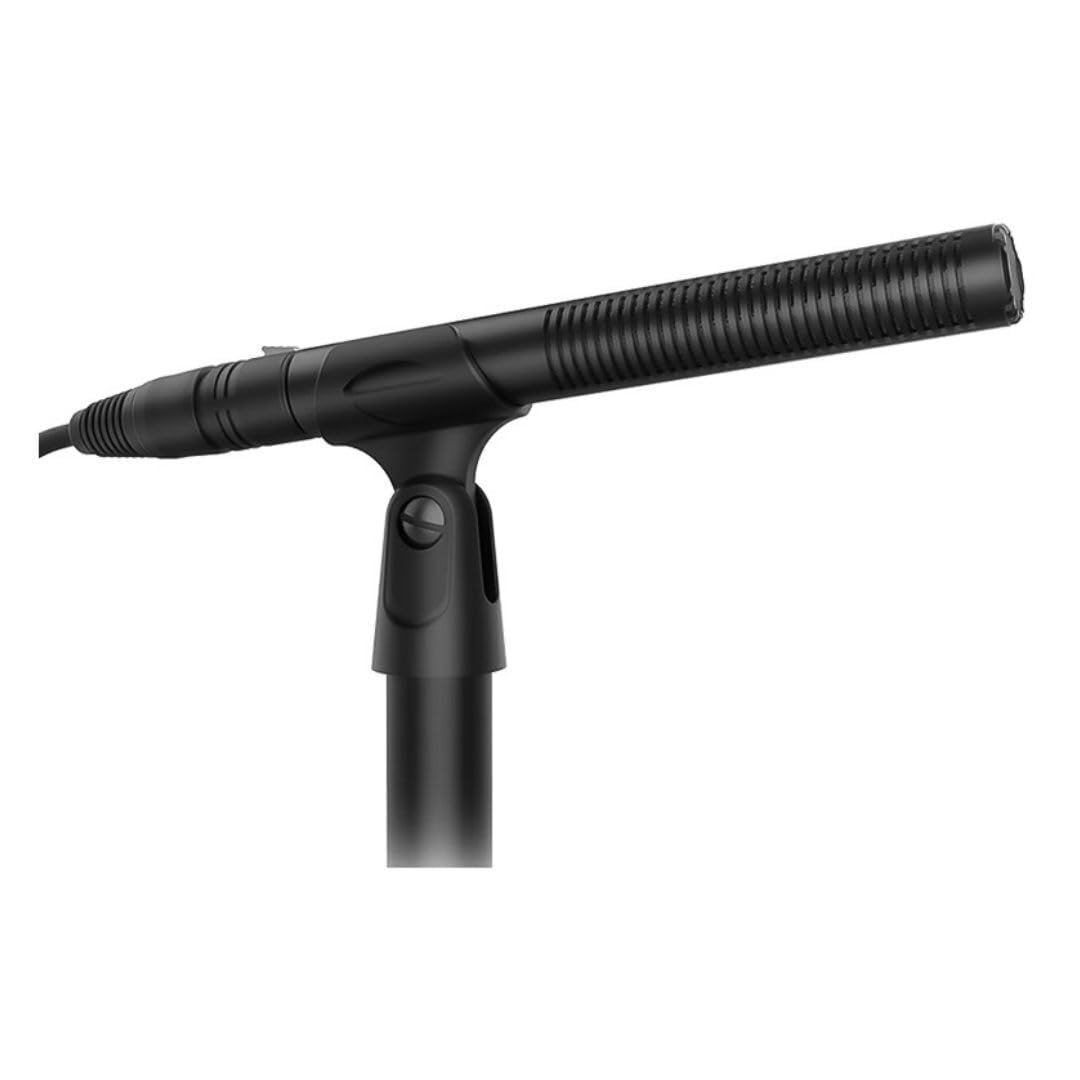
Sennheiser MKH 50
While technically a super-cardioid microphone rather than an interference-tube shotgun, the MKH 50 is essential to discuss in the context of film production. In the industry, the “MKH 50” is the de facto standard for indoor dialogue. Because it lacks an interference tube, it does not suffer from the phase coloration that occurs when sound bounces off indoor walls. It is exceptionally quiet, allowing for high-gain applications, and provides a rich, intimate sound. If your primary work is indoor studio recording or narrative filmmaking in interior spaces, this is often a superior choice to any traditional shotgun microphone.

Sennheiser MKE 600
The Sennheiser MKE 600 is one of the most widely used entry-level professional shotgun microphones for filmmaking, documentary work, interviews, and video production. Its ability to operate via phantom power or internal battery makes it particularly practical for mirrorless cameras, DSLR rigs, field recorders, and compact filmmaking setups. The microphone offers focused dialogue capture with solid off-axis rejection, while remaining accessible to independent filmmakers and creators moving beyond basic on-camera audio solutions.

Elite Cinema Audio: Schoeps CMIT 5U
The Schoeps CMIT 5U is widely regarded as one of the most respected high-end shotgun microphones in professional cinema and television production. Known for its exceptionally natural off-axis response and refined dialogue capture, it is commonly associated with premium production sound workflows and high-end location recording.
Unlike many traditional shotgun microphones that can sound harsh or phase-heavy when actors move slightly off axis, the CMIT 5U is prized for maintaining a smooth, realistic tonal character across changing positions and complex acoustic environments. This makes it particularly valued in narrative filmmaking, dramatic dialogue scenes, and demanding production conditions where natural voice reproduction is critical.
The microphone is frequently discussed alongside other elite cinema standards such as the Sennheiser MKH 416 and DPA shotgun systems, though many production sound mixers consider the CMIT 5U especially refined for cinematic dialogue work. Its premium price and specialist positioning place it firmly within the upper tier of professional filmmaking audio equipment. Official website: Schoeps CMIT 5U
Official Schoeps CMIT Technical Video Series
If you’d like to explore the engineering behind the CMIT series in greater depth, Schoeps has published an excellent multi-part video series covering the microphone’s design, acoustic principles and practical production use.
Workflow Considerations and Integration
Your microphone is only as good as the signal chain behind it. When using high-end shotgun microphones, you must ensure your preamplifiers are capable of providing clean, low-noise gain. Portable field recorders with professional XLR inputs and high-quality preamps (often featuring 32-bit float recording) are highly recommended for filmmaking, documentary production, and location sound work. If you are integrating these microphones into a home studio workflow, ensure you are using a high-fidelity XLR audio interface capable of supplying stable 48V phantom power. Poor preamplification will negate the benefits of a professional-grade capsule, introducing noise floor issues that cannot be fixed in post-production.
Furthermore, microphone handling is as critical as microphone selection. Proper shock mounting is non-negotiable. The vibrations from operating a boom pole or handling a camera can easily transfer to the microphone capsule, creating low-frequency rumble that ruins a take. Always use a professional-grade suspension mount and, when working outdoors, utilize the appropriate windshielding or “dead cat” covering to mitigate wind noise. For longer dialogue takes and cinematic tracking shots, lightweight boom poles with balanced handling characteristics can significantly improve microphone placement accuracy and operator control.
Common Mistakes to Avoid
- Ignoring off-axis colouration: Assuming a directional microphone will maintain the same tonal balance regardless of placement. Accurate boom positioning and consistent aiming are essential, particularly when performers move during a take.
- Over-processing in post: Using aggressive noise reduction or EQ to compensate for poor microphone placement or problematic acoustics. Improving the recording at source will usually produce a more natural result than attempting to repair it afterwards.
- Underestimating wind noise: Assuming a foam windscreen is sufficient for outdoor recording. Stronger wind conditions typically require furry or basket/blimp wind protection appropriate to the environment.
- Misjudging indoor acoustics: Using a long shotgun microphone in a small, reflective room can produce coloured, hollow or reverberant dialogue as reflections interact with the interference tube. In these environments, closer placement or a supercardioid or hypercardioid microphone may produce a more natural result.
Conclusion
Selecting a shotgun microphone requires balancing your environment, your subject matter, and your production capabilities. For those operating primarily outdoors in variable weather, the Sennheiser MKH 416 remains a staple for good reason. For those who prioritize a neutral, transparent sound for high-end dialogue, the Schoeps CMIT 5U is a premier investment. If your work is primarily indoors, consider pivoting toward a super-cardioid like the Sennheiser MKH 50 to avoid the inherent acoustic artifacts of interference tubes. Ultimately, the best microphone is one that suits the acoustic space you are working in and allows you to capture clean, clear, and usable dialogue that requires minimal intervention in the editing suite.
Related Microphone & Recording Guides
- Best Lavalier Microphones for Interviews & Video Production
- Best Wireless Microphones for Filmmaking & Content Creation
- Best Portable Audio Recorders for Field Recording & Production Audio
- Best Audio Interfaces for Voice Recording & Production
- Best Dynamic Microphones for Podcasting, Voice & Broadcast
- Best Condenser Microphones for Voice Recording & Studio Production
- Best Headphones for Audio Editing, Recording & Production
- Best Studio Monitors for Audio Production & Editing
- How to Start a Podcast: Recording, Equipment & Publishing Guide
Frequently Asked Questions
Do I need a shotgun microphone for YouTube? Not necessarily. If you are recording in a controlled, indoor home studio, a shotgun microphone may actually sound worse than a standard condenser or dynamic microphone due to room reflections. Shotgun microphones are best reserved for when you need to reject background noise or are shooting in larger, more open spaces.
What is the difference between a long and short shotgun? A long shotgun microphone generally provides more directionality and better off-axis rejection at greater distances. However, they are more difficult to aim precisely. Short shotgun microphones are more versatile, easier to handle on a boom pole, and provide a wider pickup area, making them more forgiving for the operator.
How do I handle the “boxy” sound indoors? The “boxy” sound is usually a result of room reflections entering the interference tube of the shotgun microphone. You can mitigate this by moving the microphone closer to the subject, using acoustic treatment (blankets, panels) in the room, or switching to a super-cardioid microphone that does not use an interference tube.
Is 48V phantom power required? Most professional shotgun microphones require 48V phantom power via XLR connectivity, though some models such as the Sennheiser MKE 600 can also operate using internal battery power for greater flexibility with DSLR and mirrorless camera setups.