

How Loudspeakers Work (2026): Drivers, Cabinets, Dispersion & Speaker Buying Explained
In This Guide
- Voice as a Loudspeaker Test
- From Signal to Sound: What a Loudspeaker Actually Does
- Cabinets, Enclosures, and Controlled Resonance
- Dynamics, Transients, and Speech Reality
- Dispersion, Space, and Real Rooms
- Active and Passive Loudspeakers
- Listening Before Buying
- Loudspeakers – Common Questions Explained
In my experience working with vocal artists and speakers, audio systems are often chosen emotionally rather than practically. A brief demonstration can impress, but sound quality reveals itself over hours and days — not seconds. Fatigue, clarity and intelligibility only emerge with time. In retail environments, loudspeakers are often demonstrated under idealised conditions that favour immediate impact rather than long-term listening reality.
Audio systems exist across an enormous range, from compact bookshelf speakers and wireless systems to large floorstanding and reference installations, yet their purpose remains constant: to reproduce sound clearly, comfortably and honestly. Loudspeakers should be understood not as isolated objects, but as part of a complete listening environment — interacting with room acoustics, voices, placement and listening habits.
This perspective is particularly relevant when navigating modern hi-fi equipment, where speaker technologies, product ranges, room sizes and listening formats vary considerably. Understanding how a loudspeaker actually works makes it easier to distinguish meaningful engineering differences from specifications or features that may have relatively little effect in a real listening environment.
This guide examines loudspeakers from a voice-centred perspective, focusing on how sound is produced, controlled, dispersed and perceived in real rooms — and how these principles can help you evaluate speakers more intelligently before buying.
To explore how real manufacturers apply these concepts in modern products, see my guide to major speaker brands.
Voice as a Loudspeaker Test
The human voice is the most revealing sound a loudspeaker can reproduce. Unlike music, it offers no disguise: timing errors, tonal imbalance, and distortion are immediately apparent. If a loudspeaker handles speech naturally, it will usually handle everything else well.
This is why clarity, coherence, and intelligibility matter more than spectacle. Loudspeakers succeed or fail on voice first — regardless of size, format, or price.
From Signal to Sound: What a Loudspeaker Actually Does
A loudspeaker does not reproduce sound in a digital sense. It converts electrical variation into controlled mechanical movement, and that movement displaces air. What matters here is not resolution or bit depth, but mass, compliance, damping, and how energy is released into space.
Every design decision downstream — cabinet construction, crossover behaviour, room interaction — begins at this physical interface between motion and air. Loudspeakers are mechanical acoustic systems, not digital devices.
Inside a Loudspeaker Driver
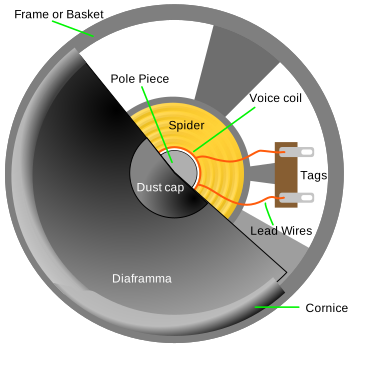
At the core of most loudspeakers is the dynamic driver, where electrical energy is transformed into sound through precise mechanical motion. The voice coil moves within a magnetic field, driving the diaphragm forward and backward while the spider and surround control alignment and stability. This balance of force, damping, and geometry determines how accurately a loudspeaker reproduces vocal detail, dynamics, and tonal balance. Understanding this internal structure explains why driver design, not just size or power, is fundamental to clarity and long-term listening comfort.
“Speaker cross section” by Iain, via Wikimedia Commons — licensed under CC BY-SA 3.0.

How a Loudspeaker Works
This diagram shows the essential loudspeaker process: an electrical audio signal drives a voice coil within a magnetic field, causing the diaphragm to move and generate sound waves. Every modern loudspeaker, from a small bookshelf speaker to a large concert system, operates on this same principle.

Why Physical Construction Matters
This cutaway view shows how the major components of a loudspeaker fit together as a single mechanical system. The diaphragm, voice coil, surround, spider, and magnet must operate in precise coordination. The accuracy of this assembly determines how faithfully a loudspeaker reproduces speech, singing, and music.
Image credit: “Loudspeaker Cutaway View” by Iain, via Wikimedia Commons — licensed under CC BY-SA 3.0

Driver Technologies: The Heart of the System
At the core of every loudspeaker lies the driver. The diaphragm, surround, dust cap, and motor structure determine how accurately motion is translated into sound. Material choice, stiffness, and geometry directly affect transient response, tonal balance, and vocal clarity.
Modern loudspeaker design spans a wide range — from compact bookshelf speakers to large reference systems — yet all rely on the same fundamental principles. Differences lie not in superiority, but in trade-offs: bandwidth versus control, efficiency versus extension, scale versus intimacy.

Horn Loudspeakers and Acoustic Loading
Horn loudspeakers operate by shaping how sound energy leaves the driver, rather than by altering the signal itself. By gradually expanding from a narrow throat to a wider mouth, the horn controls acoustic impedance and directs sound efficiently into the listening space. This approach improves projection, reduces wasted energy, and allows clarity to be maintained even at lower power levels. Horn loading is therefore best understood as a spatial and acoustic solution, not an electronic one.
Horn loudspeaker animation by Chetvorno — CC0 1.0 Public Domain (via Wikimedia Commons)
Cabinets, Enclosures, and Controlled Resonance

Loudspeaker cabinets are not passive boxes; they are mechanical control systems. Their role is to absorb, redirect, and dissipate energy that should never reach the listener. As cabinets grow larger and more complex, the goal is not louder bass, but greater control over midrange resonance — the region where voice lives. Increased mass, internal bracing, and carefully tuned volumes reduce delayed energy, cabinet talk, and time smear. This is why serious loudspeakers become heavier, thicker, and more expensive long before they become visually impressive.
Crossovers, Timing, and Integration
Where drivers define character, crossovers determine whether that character holds together. Most loudspeakers rely on multiple drivers working together. Crossovers determine how frequencies are divided and how those drivers integrate in time and phase.
At this point, the challenge is no longer the driver itself, but how multiple drivers behave as a single voice.

Poor integration creates confusion: blurred consonants, uneven tone, and listening fatigue. Well-designed systems prioritise timing, coherence, and smooth transitions — qualities that are immediately apparent in spoken word and dialogue.
This is an area where more advanced designs often invest heavily, not to impress, but to disappear.
Dynamics, Transients, and Speech Reality

Clarity is not a function of loudness. Micro-dynamics — the subtle rise and fall of speech — matter far more than raw output. Consonants, articulation, and breath require speed and control, not power.
Some loudspeakers impress initially but fail over time, particularly with dialogue. Others remain comfortable and intelligible for hours. The difference lies in transient behaviour and energy control, not headline specifications.
Dispersion, Space, and Real Rooms
Sound does not exist only on-axis. How a loudspeaker behaves off-axis — how it fills a room — is fundamental to intelligibility and comfort.
Lower frequencies radiate broadly, while higher frequencies become directional. Because clarity lives higher in the spectrum, dispersion patterns determine whether speech remains intelligible across a space or collapses into harshness and reflections.
This is why smaller speakers can outperform larger systems in certain rooms, and why flagship loudspeakers demand space to function properly.
How Speaker Dispersion Is Measured
Speaker designers do not only tune tone; they measure how sound spreads into a room. These polar plots show how a column loudspeaker’s radiation pattern changes with frequency: lower frequencies behave more broadly, while higher frequencies become increasingly directional. This matters for voice and speech intelligibility because consonants and clarity live higher up the spectrum—so coverage, reflections, and off-axis behaviour become part of the “sound” you hear, not an afterthought.
Image credit: Binksternet — “Bosch 36W column loudspeaker polar pattern” (2008), public domain, via Wikimedia Commons.

Active and Passive Loudspeakers
Active loudspeakers integrate amplification and control within the system, allowing designers tighter command over timing and behaviour. Passive systems offer flexibility and long-term adaptability, but place more responsibility on system matching.
Neither approach is inherently superior. What matters is coherence, control, and suitability for the intended environment.
No loudspeaker manufacturer offers a universal solution. Differences between designs reflect trade-offs in scale, dispersion, control, efficiency, and integration. Understanding these approaches helps listeners interpret why certain systems succeed in specific rooms and contexts—and why careful listening matters more than specifications alone.
Listening Before Buying
Listening to loudspeakers should not begin with music designed to impress. Highly produced tracks often mask timing errors, tonal imbalance, and dispersion problems through compression, layering, and studio effects. Speech and unprocessed voice do the opposite: they expose weaknesses immediately. In many retail showrooms in the UK, Europe, and the US, listening sessions are brief, volume-forward, and music-led. These conditions can favour speakers that impress quickly, while masking issues that only appear during extended, low-level listening at home.
When listening to spoken word, pay attention to consonant clarity, vocal weight, and the stability of the voice within space. A well-designed loudspeaker allows speech to remain intelligible at low levels, without forcing the listener to concentrate. If words feel detached from the cabinet, or if sibilants sharpen as volume increases, the system is already under strain.
Extended listening is essential. Fatigue does not come from loudness alone, but from poor transient control, uneven crossover integration, and uncontrolled energy decay in the room. These issues rarely reveal themselves in short demonstrations. They appear over time, as attention drifts or listening becomes effortful.
The most reliable loudspeakers do not draw attention to themselves. They allow the listener to follow meaning, phrasing, and intent without analysing sound quality at all. When technology recedes and comprehension remains effortless, the system is doing its job.
In practice, these factors determine whether a loudspeaker supports sustained listening in real rooms, or merely performs well under brief, controlled conditions.
Loudspeakers – Common Questions Explained
Are loudspeakers digital devices? No. Loudspeakers are mechanical acoustic systems. They convert electrical variation into physical movement, which displaces air. While digital processing may occur upstream, the loudspeaker itself operates entirely in the physical domain, governed by mass, compliance, damping, and resonance
Why do some speakers sound impressive at first but tiring over time? Initial impact often comes from elevated treble, boosted bass, or exaggerated dynamics. Over longer listening sessions, these choices can cause fatigue, blur speech intelligibility, and amplify room reflections. Long-term comfort depends on transient control, midrange coherence, and how energy decays in real spaces
Is speaker “resolution” a real specification? Not in a meaningful acoustic sense. Resolution is commonly used as shorthand for low distortion, clean transients, and controlled dispersion. These qualities emerge from mechanical design and system integration, not from a single measurable specification
Do larger speakers always sound better than smaller ones? No. Larger systems provide greater scale and dynamic headroom, but they also require space and careful placement. In many domestic rooms, smaller speakers with controlled dispersion and accurate timing can deliver clearer speech and more natural balance than physically imposing designs
What matters more for voice clarity: the speaker or the room? They are inseparable. A well-designed loudspeaker can minimise room interaction problems, but no speaker exists independently of its environment. Dispersion behaviour, placement, and listening distance determine whether speech remains intelligible or becomes smeared by reflections
Are active speakers better than passive speakers? Neither approach is inherently superior. Active designs allow tighter system control and consistency, while passive systems offer flexibility and long-term adaptability. What matters is coherence, timing, and suitability for the intended space and listening context
Why is the human voice such a reliable test for loudspeakers? The voice immediately exposes timing errors, tonal imbalance, and distortion. Unlike music, it cannot hide behind production choices. If a loudspeaker reproduces speech naturally and without strain, it will usually perform well across a wide range of material
How should I listen when choosing loudspeakers? Listen quietly, for extended periods, using speech and familiar voices. Avoid short demonstrations designed to impress. The best loudspeakers disappear over time, allowing content—not sound—to hold your attention.
Closing Perspective
I’ve learned over time that buying loudspeakers is rarely a single decision. Whether someone starts online, reading reviews and comparing models, or visits physical retailers to hear systems in person, the process usually unfolds in stages. First impressions matter, but they are rarely decisive. What stays is what continues to feel natural after the novelty fades.
Sound quality reveals itself slowly. We explore different modes of listening — music, speech, silence, background sound — and often return to familiar voices or pieces of music that carry personal meaning. For many people, listening is not entertainment alone; it becomes a form of concentration, reflection, or even quiet meditation. In those moments, exaggerated sound becomes tiring, while balance and ease become essential.
This is why learning matters before purchasing. Understanding how loudspeakers work, how rooms influence sound, and how different design philosophies approach clarity allows choices to be made with less pressure and more confidence. Online specifications, showroom demonstrations, and expert opinions are useful — but none replace time, repetition, and personal reference.
The loudspeakers that remain satisfying are rarely the ones that demand attention. They are the ones that allow listening to happen without effort — whether through speech, music, or silence — and that continue to feel right long after the decision has been made. When that happens, the system stops being something you evaluate and becomes something you live with.
More in this category

Major Speaker Brands & Design Philosophies (2026 Guide)
Explore the world’s leading speaker brands and modern loudspeaker design philosophies…

How to Choose the Right Speakers: Complete Home Audio Guide
Find the best speakers for London flats and UK homes. Compare…
Discover more

SOVT Exercises for Singers — Practical Methods for Vocal Coordination
SOVT exercises are among the most effective tools for improving vocal…

How Nebulisers and Steam Inhalers Work for Singers: A Guide to Vocal Hydration and Respiratory Support
Professional guide to nebulisers, steam inhalers, and vocal hydration for singers,…

The Mechanics of Human Breathing for Singers (2026 Guide)
Explore the mechanics of human breathing for singers, including diaphragm function,…

11 Reasons Why Your Breathing Defines Your Voice
Breathing is the most natural act we perform every moment of…

Diaphragmatic Breathing Exercises for Singers & Speakers
I trust nowadays singers don’t give too much attention to a…

How Breathing and Yoga Improve Breath Support, Vocal Control & Singing Performance
Many singers and speakers unknowingly limit their voice through hidden tension…

Mastering the Breath: Proven Techniques for Voice, Power & Control
From free divers to mountaineers, from athletes to astronauts, breath unites…

How to Sing Better: Vocal Coach Strategies for Success
We need to use a specific pressure of air for different…

12 Best Vocal Exercises for Beginners: Build a Strong Foundation
In This Guide Essential Vocal Exercises for Beginners A good beginner…

The Role of Posture in Professional Singing
When I first started taking my singing seriously, everyone told me, “Stand…

Hydration and the Singer’s Voice
If there’s one principle I return to almost every day —…

Benefits of Singing: How Singing Supports Wellbeing, Breathing & the Brain
Explore how singing supports wellbeing through breathing, brain activity, emotional expression,…